
Sure, Pyrex and Le Creuset get all the attention in collectible kitchenware circles, but seasoned collectors know there’s so much more out there worth hunting for. Legry, a French maker of hand-crafted copper cookware from the late 1800s and early 1900s, churned out some seriously gorgeous saucepans, pots, and kitchen gear that blended style with killer craftsmanship. Copper cookware’s making a comeback lately, and honestly, spotting a real Legry piece feels like finding treasure. Legry’s story is pretty intertwined with Alfred Duval, a well-respected French coppersmith who ran a solid metal shop in Paris back in the 1800s. Then in 1896, Paul Legry bought Duval’s copper cookware business and kept the tradition alive, cranking out top-notch handmade cookware from their Paris workshop. This shared past means collectors often lump Duval and Legry together—they’ve got similar roots and comparable quality. Before stainless steel and nonstick stuff took over, pro chefs absolutely loved copper because it heats up evenly and cooks food like a dream. Legry went with thick-gauge copper, which is key because that thickness stops the pan from warping when things get hot and keeps your food from burning in those annoying hot spots. Since Legry pieces were handmade in limited runs from just one workshop through the 1930s, they’re super hard to find these days. You might snag some everyday vintage copper cookware for a reasonable price, but if you want the real deal Legry? Be ready to drop some serious cash. We’re talking a few hundred bucks for a basic saucepan, and upwards of $1,500 for a fancy sauté pan, depending on how rare and nice it is. Davide Marzotto/Shutterstock
How to spot Legry copper cookware
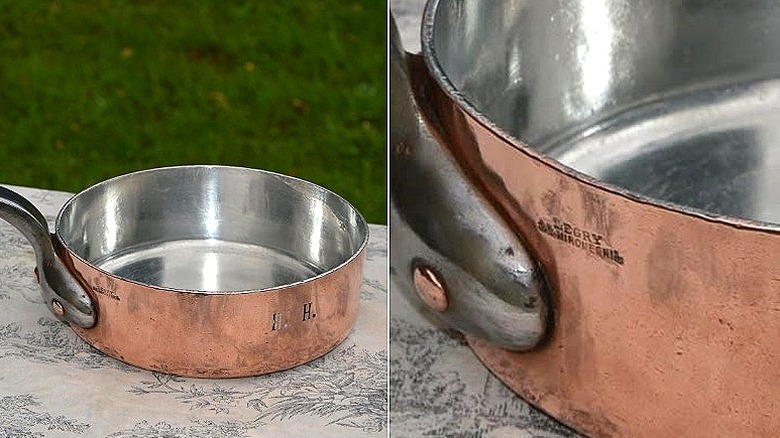
A Legry saucepan or copper pot is a window into the days when craftspeople made cookware with real skill and care. Since you might stumble upon something incredible, it’s always smart to give copper pieces a good once-over. The first thing to look for? The maker’s mark.
Real Legry pieces usually have stamps or engravings with the Legry name and the shop’s street, Miromesnil. You’ll see marks like “2.R.MIROMESNIL,” where the “R” is short for Rue, which is French for street. Experts figure this mark showed up pretty soon after Legry took over the business. Then there’s a rarer stamp: “P. LEGRY 2 R. DE MIROMESNIL PARIS”—no one knows exactly when this one was used. As time went on, Legry switched to stamping “Cuverie Standard” with Legry tucked in the middle. Those pieces are thought to be from around 1923-1925, based on what we know.
Just like with other collectibles, condition matters big time when it comes to Legry’s value. Collectors hunt for pieces with sturdy thick copper, handles that are still intact, clean insides, and original details instead of stuff that’s been beaten up or repaired. Part of what makes vintage copper cookware so cool is that you can often see the fingerprints of the person who made it. When you spot little imperfections on a copper piece, that’s actually a good sign—it usually means it was shaped by hand the old-fashioned way, since Legry pieces were hand-hammered.