
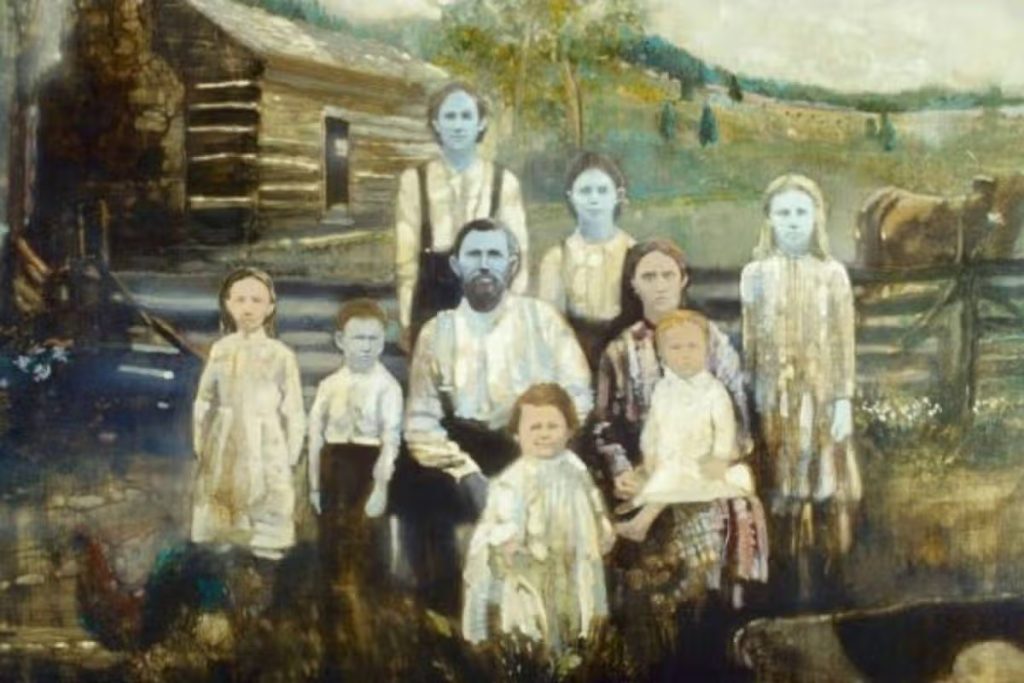



Deep in the Kentucky countryside, one family passed down a trait so rare that parents were stunned when their babies arrived with blue skin. The Fugates of Troublesome Creek lived so far from everyone else that marrying relatives became common. Over the generations, that helped spread a rare genetic condition that doctors could not explain for decades.
A blue-skinned settler
The story begins with Martin Fugate, who came to the United States from France around 1820 and settled at Troublesome Creek. He is thought to have been born with blue skin, and his parents are said to have been so alarmed that they left him at an orphanage.
In Kentucky, Martin met and married Elizabeth Smith. By remarkable chance, she carried the recessive gene for the very same condition. The couple had seven children, and four of them were blue.
The valley had no road connections to the outside world, and only four other families lived there: the Combs, the Richies, the Smiths and the Stacys. With so few people to choose from, relatives married one another again and again. One of Martin and Elizabeth’s sons, Zacharia, married his own aunt, while another son married a first cousin.
One descendant, Luna Fugate, was described as "blue all over", with lips "dark as a bruise". She married John Stacy in the late 1800s and they had 13 children. Despite their unusual colouring, the children were healthy in every other way, even though this condition normally brings serious problems such as developmental delays and seizures.
Solving the mystery
The cause stayed hidden until the 1960s, when Madison Cawein, a hematologist at the University of Kentucky, met two blue-skinned people at a local clinic. After ruling out heart and breathing problems, he diagnosed methemoglobinemia. In this condition the body makes too much methemoglobin, a variant of hemoglobin, which gives the blood a dark, bluish tint that shows through the skin. It is usually inherited, though certain drugs or chemical exposure can occasionally trigger it.
Dr Cawein suspected the family lacked an essential enzyme. He tried a blue substance called methylene on some of them, and their skin returned to a typical colour for several days before turning blue again. He then recommended that the family take regular medication to manage their skin tone.
A baby who made headlines
The family drew nationwide attention in 1975, when Benjamin Stacy was born with skin "blue as Lake Louise". Within hours he was rushed to the University of Kentucky Medical Center for a blood transfusion. Then his grandmother pointed out how much he resembled the Fugates of Troublesome Creek.
It later emerged that his great-grandmother was Luna Fugate, regarded as the "bluest" woman on record.
The family today
The condition has not completely vanished. Hazel Fugate says her 69-year-old husband, Gary, a descendant of Martin, still lives with methemoglobinemia. It is milder than in earlier generations, but she says that in low light "the colour of his skin is a blue purple", and it has become more noticeable as he has aged.
The couple’s son was born with the same condition but seemingly outgrew it by his fifth birthday. Their daughter appeared to show symptoms for only a few months.
Image credit: HistoryExtra
Source: The Mirror US

Leave a Reply