
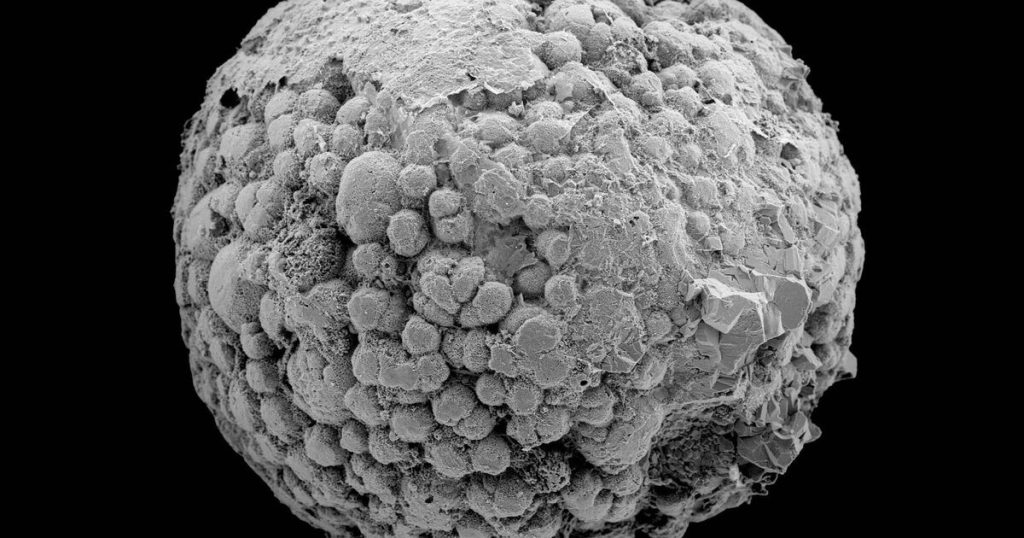



Animals may have appeared up to 200 million years earlier than the fossil record suggests, according to a new study led by researchers at Oxford University. The finding challenges a key assumption scientists have used to decide when animal life began, and it points to a hidden chapter in evolution that may have unfolded before some of the harshest ice ages in Earth’s history.
The work, published in the journal Science Advances, tackles one of evolution’s biggest puzzles. Animals seem to appear "relatively suddenly" in the fossil record just before the Cambrian Period, which ran from 539 to 487 million years ago. The researchers think that sudden arrival may partly be an illusion created by gaps in the evidence.
A famous fossil site and a shaky assumption
Much of the debate centres on the Weng’an Biota in China, a deposit of rocks about 590 million years old. It preserves microscopic organisms in remarkable detail, yet none of them is a definite animal. Many scientists have reasoned that if animals had existed then, such an exceptional site would have captured them.
The new team set out to test that logic. They surveyed exceptionally well-preserved microfossils from the Kheseen Biota in Mongolia, a site more than 40 million years younger than Weng’an.
Beautiful fossils, but no animals
The researchers examined more than 140 samples using scanning electron microscopy. They found "exquisite" new microfossil species, including acritarchs and embryo-like fossils containing internal cells. Even so, none could be firmly identified as an animal.
Senior author Professor Ross Anderson, of Oxford’s Museum of Natural History, said the Kheseen microfossils are just as well preserved as those at Weng’an, "yet animals continue to be absent", even though we know they existed by then.
Rewinding the molecular clock
With Weng’an no longer a firm cut-off, the team looked much further back, at deposits from roughly 850 to 730 million years ago, including sites in Norway, Australia and Arizona. All are rich in fossils and could have preserved animals, but no animal remains have turned up there.
Using these older limits, the researchers ran a molecular clock analysis, which compares genetic differences between living species to work out when their ancestors first lived. The result pushed the likely origin of animals back by about 200 million years, to between 800 and 700 million years ago. The researchers say the earliest animals would have been small and soft-bodied, so they would rarely have been fossilised.
Animals and Snowball Earth
An origin that early raises what Professor Anderson called "striking possibilities". Animals may have evolved before Earth entered some of its most extreme ice ages, or even during them. The study reopens the question of whether Snowball Earth conditions shaped the early evolution of animals.
Lead author Orin Lole Durbin, an Oxford graduate now doing a PhD at Virginia Tech, urged caution. Fossils of animal bodies from before the Ediacaran still elude scientists, he said, and the analysis does not prove animals lived 800 million years ago. But the Mongolian fossils weaken one of the main arguments for limiting animal origins to the Ediacaran, and the molecular clock shows how much further back their history could stretch.
Source: Daily Express US

Leave a Reply