
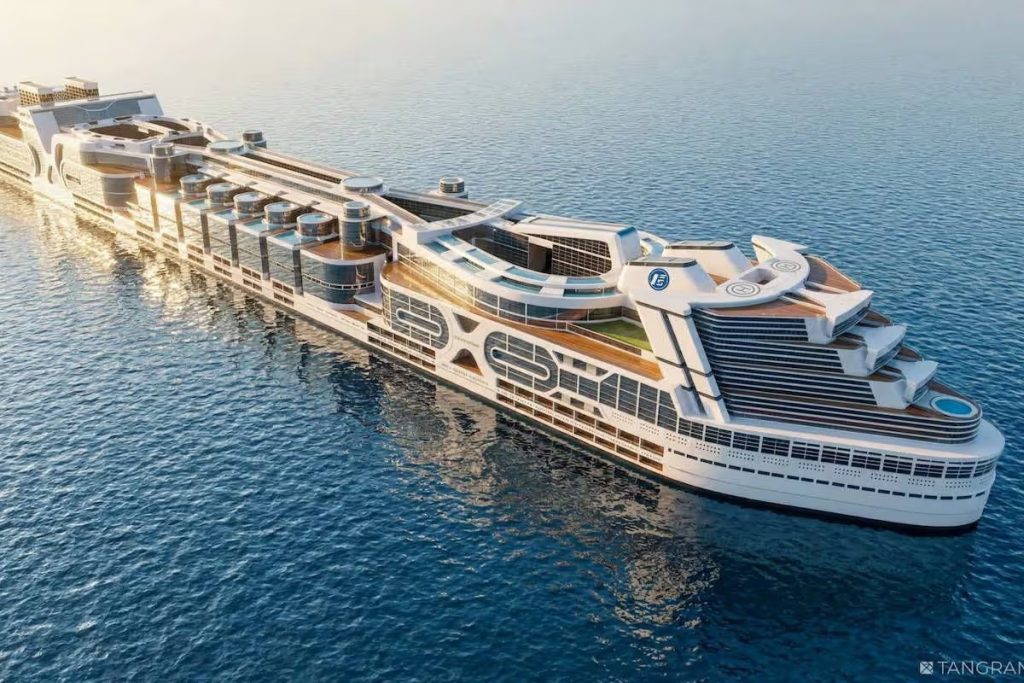



A proposed vessel called Freedom Ship is designed to be a mile long, 800 ft wide and 30 stories tall, and to carry up to 80,000 people. Its backers describe it as a floating city that never settles in one port, and next to it today’s biggest cruise liners would look small.
A city that never docks
Royal Caribbean’s sister ships Star of the Seas and Icon of the Seas currently hold the title of the world’s largest cruise vessels. Each is nearly a quarter-mile long and carries roughly 5,600 guests. Even placed end to end, the pair would measure only half the length of the Freedom Ship.
The project carries a price tag of £12bn and would weigh in at more than 2 million gross tons. It is designed to circle the globe continuously without a permanent port, powered by an onboard nuclear power plant. Plans include a performance venue, conference facilities, an aquatic park and a 15,000-seat athletic arena.
At full capacity the ship would hold about 80,000 people: roughly 50,000 full-time residents, 20,000 crew and 10,000 guests. That is about the population of St Albans in Hertfordshire.
From a 1990s dream to a full-time team
The idea was first put forward in the 1990s by American engineer Norman Nixon. He pictured a libertarian-style community living and working mostly in international waters, largely outside any single government’s control.
This March, Freedom Cruise Line announced a significant step forward. It has appointed a project manager, a designer and a naval architect to work on the plan full-time.
Chief executive Roger Gooch says money is now the main obstacle. "We feel very confident that we can put this together, but the capitalisation is key," he said. He hopes entrepreneurs will lease or buy space on board, including the nightclub and hotel areas, "just like they would in a land-based community".
Gooch also pointed to the ship’s stateless status as a selling point, saying medical research facilities have approached the company because the vessel would sit outside the reach of regulatory bodies.
Designer Kevin Schopfer said the team wanted the ship to feel human-sized. "We started with the view that the ship should not be a monolithic piece but visually comfortable, so we softened all the edges," he explained. Walkways and green spaces are planned, along with several miles of pedestrian paths and a tram to carry people from one end to the other.
The doubters
Some experts call the Freedom Ship attractive but unworkable. They worry about hull stress, since ocean swells create huge bending pressures and a mile-long hull would face extraordinary demands. Shipbuilding professionals add that no dry dock in the world is big enough for the early stages of construction.
Feeding and clearing waste for a population the size of a town poses further hurdles. Nixon’s original cost estimate was $6bn, and it has since climbed to around $16 billion, just under £12bn.
For now, the Freedom Ship remains on the drawing board, with a small team in place and the money still to be found.
Image credit: Freedom Cruise International
Source: The Mirror US

Leave a Reply