
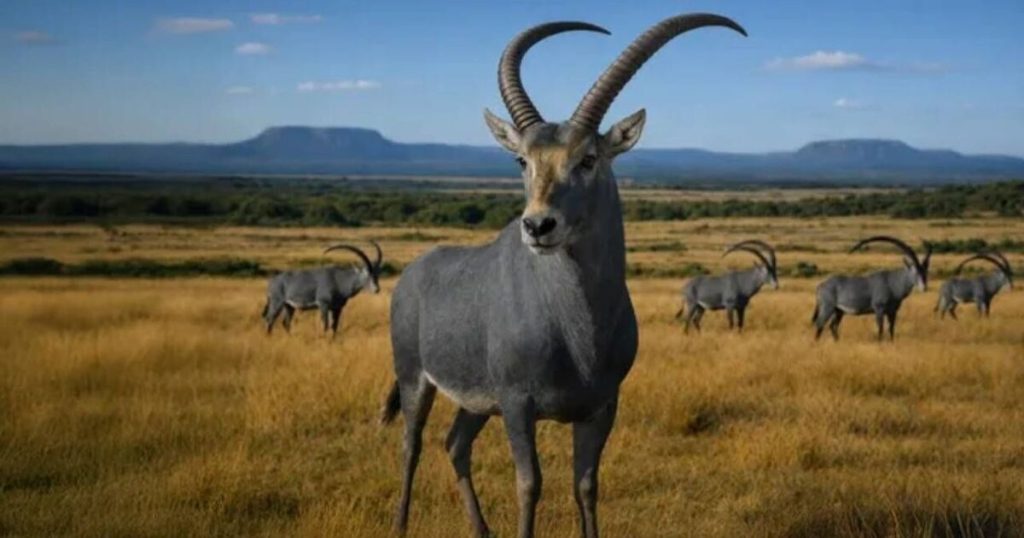



A US biotech company best known for its plans to resurrect the woolly mammoth has now turned its attention to a lost African antelope. Colossal Biosciences has announced that it is focusing on the bluebuck, an animal that became the first large African mammal driven to extinction in modern times. The company, which is also working on the dodo, the thylacine and the dire wolf, says the project is already making real progress.
An animal lost to the plough
The bluebuck once lived near the Cape of Good Hope in South Africa. When European settlers arrived, they hunted the species to extinction while turning its grazing land into farming territory.
The loss was especially painful for the Bushmen of the Caledon River Valley, who believed the bluebuck had supernatural powers and safeguarded the spiritual realm.
Why this animal
Colossal’s chief executive, Ben Lamm, explained that bovids are another family of mammals the company wants to work on. In his words, the bluebuck is "perfectly aligned with our vision of restoring apex species that have been eradicated by human intervention back to their ecosystem."
He also pointed to Yellowstone. "I hope that when Bluebucks are back in South Africa, we can see a landscape transformation similar to that of when wolves were re-introduced to Yellowstone," he said.
The idea has support from conservation groups, including Advanced Conservation Strategies, led by the conservation ecologist Dr. Josh Donlan, and the Endangered Wildlife Trust.
The science so far
Colossal says it has developed new ovum pickup techniques designed specifically for antelope, allowing egg cells to be collected from living animals in a minimally invasive, scalable way. The team also reports a first: induced pluripotent stem cells created from the roan antelope, a living relative.
The other major step involves the bluebuck itself. Working with academic partners, Colossal researchers built a nuclear genome with 40-fold coverage from a historical bluebuck specimen held at the Swedish Museum of Natural History. The company says this is one of the highest-quality ancient genomes ever put together for an extinct species.
The work was led by Dr. Michael Hofreiter, a member of Colossal’s Scientific Advisory Board, and was published in the journal Current Biology.
Dr. Hofreiter said the first genetic work on bluebuck specimens, carried out with Colossal two years ago, showed that usable DNA could be recovered from the species. "These data points are now the foundation for an actual restoration project," he said. He added that the company’s technical advances were "taking us from reading ancient genomes to rewriting them for conservation."
Where things stand
The bluebuck project now rests on that high-quality genome, the new egg collection methods and the stem cell breakthrough in a related antelope. The stated goal is to see the animal restored to its home in South Africa, with conservation partners involved from the start. If it works, a species lost to farming and hunting centuries ago could once again shape the landscape it left behind.
Image credit: Instagram
Source: Daily Express US

Leave a Reply